Rosling on “100 top global thinker”-list

fpHans Rosling, founder and director of Gapminder, is one of the world’s “100 most important global thinkers” of 2009, according to Foreign Policy Magazine.

Hans Rosling comments the list on his Twitter-feed: “One of 100 top global thinker, Honored, but instead of #96 I had rather been placed after Valerie Hudson (#97).

Rosling is honored at #96 on the list for “boggling our minds with paradigm-shattering data“. The list is topped by (1) Ben Bernanke, the chairman of US federal reserve for his actions to turn the US-depression and (2) Barack Obama for “for reimagining America’s role in the world.”

Here is what Foreign Policy writes about Hans Rosling:

Rosling, a doctor and global-health professor, has become famous for his energetic lectures, in which he narrates mind-blowing statistics on development and public health — as they literally move across a screen. Imagine x-y axes filled with data points, each representing a country. As time passes, the dots move, realigning to show changes in child mortality, percentage of paved roads, unemployment rates, or pretty much any other metric you can imagine. Rosling’s quest to use numbers to shatter stereotypes of rich and poor countries has brought him global prominence.

Go to the full list…

Visualizing Swedish development aid

SADEV, the Swedish Agency for Development Evaluation maintains a database with time series data on Swedish bi- and multilateral aid allocation. The task to make sense of the development aid data is a difficult one.

Foto: Gry Hjeltnes/Sida

Which countries have received most, which sectors are biggest, and how much within a country went to different sectors, such as education or health? You also want to I know see how much aid was distributed through the different multilateral organizations.

To get things started Gapminder put the data from Sadev into a few different visualization tools.

See the result in Gapminder Labs Visualizing Swedish development aid

Open Lecture with Hans Rosling (in Swedish)

Monday 23 November, Hans Rosling will give an open lecture at Uppsala University. The title of the lecture is “Civil War, Aid, Competition and Latte – a fact based view on four types of countries”.

The lecture is given in Swedish and moderated by the science journalist Jan-Olov Johansson

Date: Monday 23 November, 2009
Time: 19:00 – 20:00
Location: Lecture room X in the University building

Read the university’s add in Swedish

New: Country graphs in Google search

World Bank data in Google SearchBack in April Google launched a search function for US public data with interactive graphing. Today, Google has made this feature much more useful with the inclusion of 17 indicators from the World Bank, including the number of internet users, life expectancy, and a host of other indicators for most of the world’s countries.

Click this link to see South Africa’s life expectancy in the new graph. Click the graph in the search result to see an interactive graph where you can compare with other countries.

Note that this currently only works when searching google.com, not country-specific sites such as google.fr.

Also read Google’s official announcement:

World Bank public data, now in search

New bubble graph: Gapminder Agriculture

cow_shadowWhich country has the largest grain production? Who produces the most fruits, vegetables, nuts, coffee beans or other crops? And who brings up the most sheeps, cows, or other livestock?

Now you can see agricultural production in a completely new Gapminder Graph. With data from FAO, we have collected over 700 indicators to show how agricultural production has changed over the last 45 years.

Here are a few examples:

Congo's income adjusted upwards in Gapminder World

Income per person for Democratic Republic of Congo has been revised. We have made an upward adjustment of the income for 2005 with 25%. We have also adjusted the growth rate from 1991 and on. Congo is still the poorest country in the world. The background and details of this adjustment  are documented in our documentation, (p. 23-25).

Children per women since 1800 in Gapminder World

The data for “Children per woman (total fertility)” has been updated to cover 195 countries from 1800-2008. It is now possible to see the entire “demographic transition” that most countries have followed: going from many children and short lives, too few children and long lives.

» Click here to see children per woman vs life expectancy in Gapminder World

Continue reading “Children per women since 1800 in Gapminder World”

TV-documentary on Hans Rosling now with subtitles

In the next 30 days you can see the Swedish TV-documentary: Rosling’s World: The best statistics you’ve ever seen, with English subtitles, on the webpage of the Swedish Television. The documentary will be aired again on Swedish Television (SVT24) on Tuesday 18 August, 20.00 in Sweden (19.00 CET) and in conjunction with that the video will be posted on SVT’s site for 30 days, this time also with English subtitles.

Continue reading “TV-documentary on Hans Rosling now with subtitles”

High income – rare in tropical land-locked countries

The role of geography for the prospects of development has been hotly debated the last decade. Economists, like Jeffrey Sachs, have suggested that a country that are situated in the tropics or that are landlocked face a much larger challenge in development, for a number of reasons.
Continue reading “High income – rare in tropical land-locked countries”

New Google feature: “public data search”

Google has just launched a new search feature that makes it possible to search and compare public data in an interactive graph. In this first version, data for unemployment, for all US states and districts, are available and the results are very interesting:
Click this link to see and investigate US unemployment rate

Also read Google’s official announcement:
Google Blog: Adding search power to public data

Hans Rosling documentary on Swedish Television

“Roslings värld”, a new television documentary about Hans Rosling produced by the Swedish Television (SVT), will soon air in Sweden. In this portait by the Swedish journalist Pär Fjällström the viewers get to follow Hans Rosling during a few weeks in the end of 2008.

Continue reading “Hans Rosling documentary on Swedish Television”

Two new videos with Hans Rosling

200 years that changed the world

– 200 years of history in 4.5 minutes.

Viewer responses to the video:

“Thanks for posting another thoroughly thought provoking video.”
“This is brilliant, compelling and amazingly well visualized.”

Shanghai, New York, Mumbai

– Is Shanghai healthier than New York? And how do Washington D.C. and Mumbai rank?

Be the first to comment this video!

Learn to use Gapminder in the classroom (in Swedish)

Are you a teacher? Do you live in Sweden? We now offer a course on how to use Gapminder materials in the classroom. The course will be in Swedish, takes place in Stockholm on 15-16 of June and the prize is 2800 SEK + sales tax. If more than one teacher come from the same school, we give a 15% discount on the prize.

If you are a teacher who don’t speak Swedish, or for other reasons cannot participate, we are still interested to hear your suggestions for how we can improve the online resources for teachers on the website. You can contact Klara Johansson if you have some valuable suggestions.

Continue reading “Learn to use Gapminder in the classroom (in Swedish)”

Hans Rosling debunks myths in new lecture-series

<br />Can the population growth be stopped? Is Brazil, Egypt and Bangladesh now improving faster than Sweden ever did? And can everyone live on the same level as the rich countries?

In a new lecture series, filmed in a studio at the Swedish Television, Hans Rosling answer yes to all questions above.

The lecture has been divided into three videos that you can find in the video-section.

Part 1 – What stops population Growth?
Part 2 – Poor beat rich in MDG race
Part 3 – Yes they can!

Resources for teachers

We are planning to develop resources and manuals to make it easier for teachers to use gapminder in their teaching.

We already have found a couple of resources on the net (see links below).

We welcome any feedback, suggestions or comments from teachers who wants to use, or are already using, the resources of gapminder in their teaching. You can post a comment on this blog or send us an email.

Continue reading “Resources for teachers”

Gapminder HIV Chart

About this Chart

Gapminder HIV Chart 2009 is a map for print. It may be redistributed under a CreativeCommons license.
The size of the country bubbles in the chart represents the Number of people living with HIV. The y-axis and x-axis shows Adult HIV prevalence rate and Income per person, respectively.
Read more about HIV Trends in the blog: “See new surprising trends in HIV”

See new surprising trends in HIV

A new data set on the HIV epidemics in each country since 1979 is now available in Gapminder World. The dataset is an expansion of the excellent UNAIDS data, and illustrates several interesting points.

Here is a moving graph with the percent adults infected with HIV in each country plotted against the GDP per capita. The size of the bubbles shows the number of people infected with HIV in each country (not the total population, as is usual in the Gapminder graphs). Click Play to see the epidemic from 1979 to 2007, and to see new surprising trends.

Continue reading “See new surprising trends in HIV”

MDG 4 – Reducing Child Mortality

MDG4

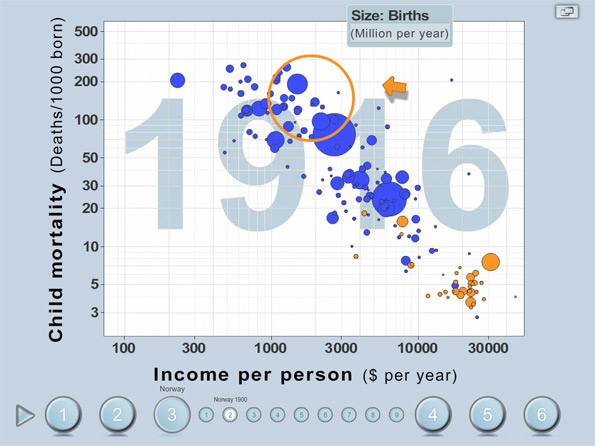
See the presentation on-line or choose download option below.

About this Flash presentation

This is the clickable presentation used in Gapminder Video #11.
You can use this presentation when you lecture, showing it from start to finish or selecting from the different chapters.

Produced in collaboration with NORAD (Norwegian Agency for Development Cooperation).

Download

PC version
Mac version